
A backflow test can feel like one more deadline on a Detroit facility manager’s calendar. But when a pressure change sends water in the wrong direction, a working assembly may be the only barrier between a business plumbing system and the public water supply. Timely backflow preventer testing helps protect people, maintain compliance, and prevent an avoidable water shutoff from interrupting operations.
Call Mr. Pipey Plumbing at (313) 896-8874 to schedule commercial backflow preventer testing.
Mr. Pipey Plumbing is a family-owned, licensed, and insured Detroit plumbing contractor serving businesses across Metro Detroit. Our team can test the assembly, explain the results, complete necessary repairs, and help keep the required documentation organized.
Why Detroit businesses need backflow preventer testing
Water normally moves from the public main into a commercial building. Backflow occurs when that direction reverses because of backpressure or backsiphonage. A pressure drop caused by a water main break, firefighting demand, or a building plumbing event can create conditions that pull non-potable water toward the drinking water system.
A backflow prevention assembly uses check valves, relief valves, or an air gap to stop that reversal. Those mechanical parts can collect debris, lose tension, or wear over time. A device that looks intact may not hold the required pressure differential. Testing provides measurable evidence that it is working as intended.
Protect customers, employees, and neighboring properties
Commercial properties often have cross-connections that do not exist in a typical home. Restaurant equipment, chemical dispensers, irrigation systems, boilers, fire suppression lines, medical equipment, and industrial processes can all create contamination risks. A failed assembly may expose more than one building because the connection leads back toward the public main.
Meet the deadline on your testing notice
Testing requirements vary by water authority, device type, installation, and hazard level. Commercial assemblies are commonly tested annually, as well as after installation, relocation, repair, or replacement. The safest approach is to follow the due date and instructions on the notice issued for your property rather than relying on a generic schedule.
Keep a copy of the notice, prior test reports, repair records, and device information. These records help the tester identify the assembly and give property managers a clear compliance history.
Which Detroit commercial properties face higher backflow risk?
Any property with a protected cross-connection may need testing, but some sites warrant especially careful planning. Detroit and Metro Detroit businesses with complex plumbing, hazardous materials, or services that cannot operate without water should treat the test as an essential maintenance event.
| Property or system | Potential cross-connection | Planning concern |
|---|---|---|
| Restaurants and food service | Dishwashing, beverage, and cleaning equipment | Schedule around food preparation and sanitation needs |
| Medical and laboratory facilities | Specialized equipment and chemical systems | Coordinate closely with facility safety procedures |
| Factories and auto facilities | Process water, wash bays, and chemical dispensers | Identify every assembly across the site |
| Office and multi-tenant buildings | Boilers, irrigation, and mechanical rooms | Notify tenants before a water interruption |
| Fire suppression systems | Stagnant or treated fire-line water | Coordinate testing without compromising fire safety |
The device selected for a site depends on the degree of hazard and local requirements. Common assemblies include double-check valve assemblies and reduced pressure zone assemblies. Property owners should not choose or change a device based only on cost. A qualified plumbing professional and the appropriate local authority can confirm what the installation requires.
What happens during a commercial backflow test?
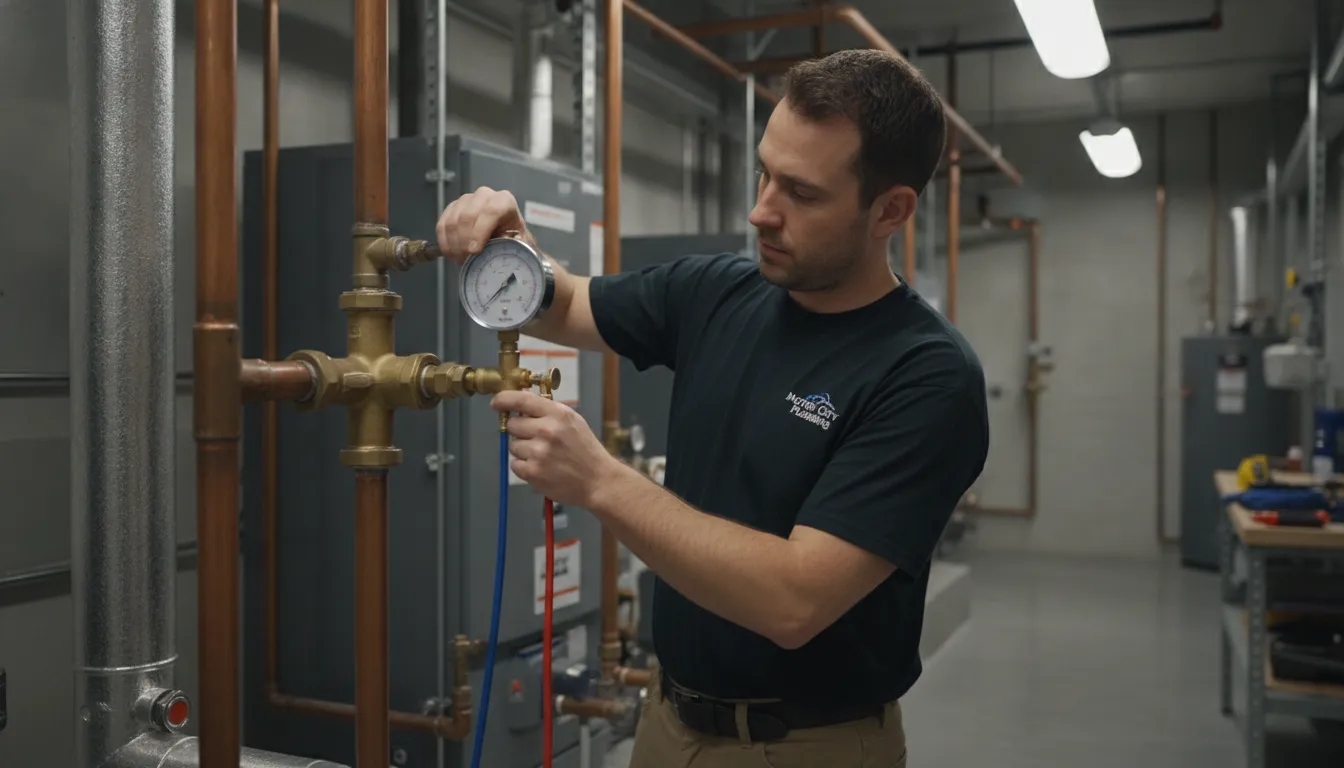
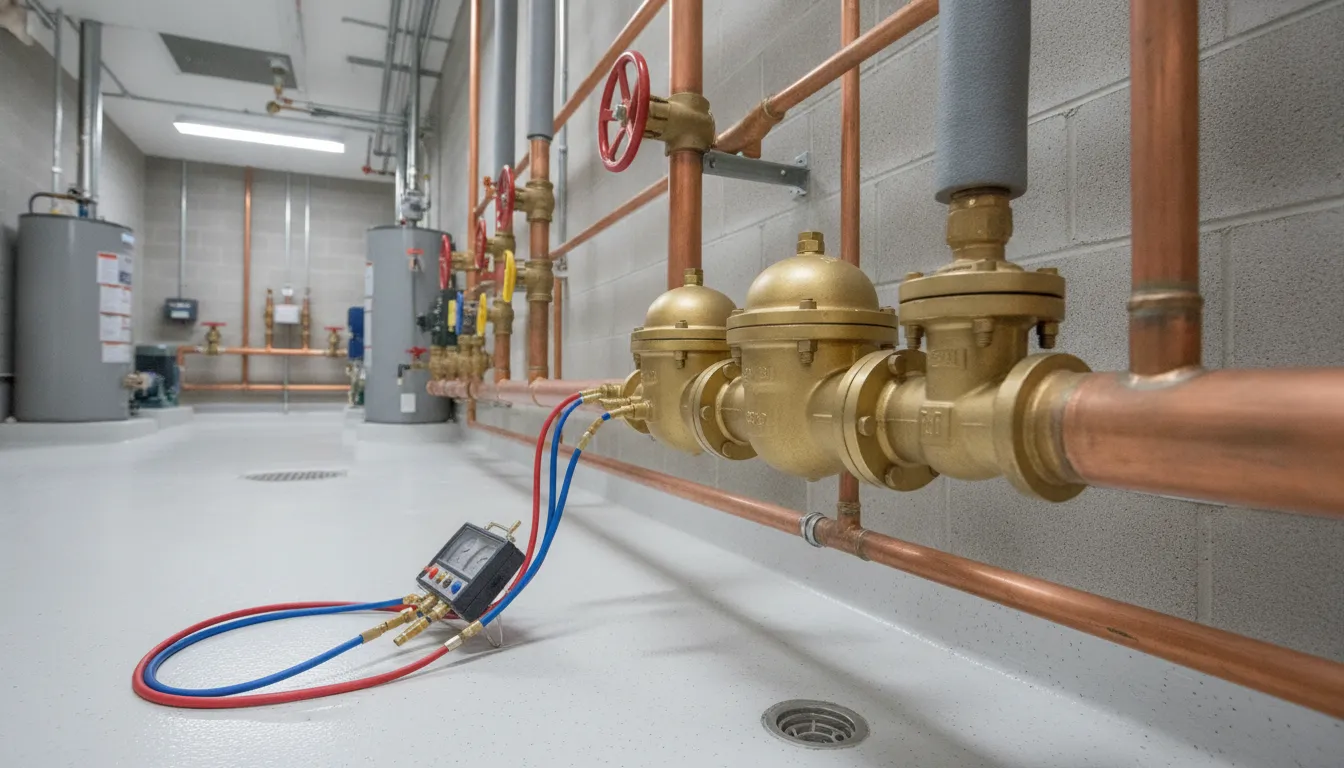
A professional test is controlled, documented, and usually straightforward when the assembly is accessible. The tester isolates the device and connects a calibrated differential pressure gauge to its test cocks. By operating the valves in a defined sequence, the tester measures whether the internal checks and relief valve respond at acceptable pressure levels.
Before the test begins
The tester confirms the assembly type, serial number, location, and service connection. They also inspect the surrounding area for visible leaks, damage, corrosion, or unsafe access. Building staff should identify every device included in the notice and provide access to locked mechanical rooms, rooftops, or exterior enclosures.
During the pressure checks
Water service through the assembly is briefly shut down. The tester attaches gauge hoses, opens the appropriate test cocks, and records the pressure readings. The exact sequence depends on the assembly. For example, a reduced pressure zone assembly includes a relief valve test, while a double-check assembly focuses on the performance of its check valves.
- Confirm the device identity and inspect its condition.
- Notify building staff before isolating the water supply.
- Connect calibrated test equipment to the assembly.
- Measure and record valve performance.
- Restore water service and check for leaks.
- Document the pass or failure and explain the next step.
A routine test often takes about 30 to 60 minutes per assembly, although access limitations, multiple devices, or needed repairs can extend the visit. Businesses can reduce disruption by scheduling the work during a slower operating period.
How to prepare your business for testing
A little preparation can make the visit faster and reduce the impact of a temporary water shutdown. Start by reviewing the notice and confirming which assembly or assemblies must be tested. Large facilities may have separate devices for domestic water, irrigation, fire protection, boilers, or process equipment.
Use this pre-test checklist
- Locate each assembly and confirm that the technician can safely reach it.
- Remove stored items that block valves, test cocks, or floor access.
- Find the previous report and any recent repair documentation.
- Tell the tester about known leaks, pressure problems, or recent plumbing work.
- Notify employees, tenants, vendors, and customers about the expected interruption.
- Choose a time that minimizes disruption to restrooms, food service, production, or cleaning.
- Arrange access to locked utility rooms and exterior enclosures.
Facility managers should also identify any operation that cannot tolerate a water interruption. The tester can discuss sequencing, but safety and testing requirements still govern the process. Never bypass a backflow assembly or open a protected connection to keep water running.
What happens when a backflow preventer fails?
A failed test does not automatically mean the entire assembly needs replacement. Many failures involve worn seals, weak springs, debris, leaking shutoff valves, or internal components that no longer seat correctly. The right repair depends on the device condition, available parts, and the measured test results.
Repair, retest, and document
The tester should explain which portion failed and what corrective action is recommended. After repair, the assembly must be tested again to confirm that it passes. The final documentation should accurately identify the assembly and record the passing measurements according to the local authority’s process.
Delaying corrective work can create compliance problems and increase the chance of a service interruption. It may also allow a small defect to worsen. Prompt repair and retesting give the property owner a clear record that the device is protecting the connection again.
Watch for related plumbing concerns
Testing may reveal more than an internal valve problem. Corroded piping, active leaks, inaccessible valves, or unstable pressure deserve attention as part of the broader plumbing system. If the area has drainage issues, Mr. Pipey’s commercial drain cleaning services may help address a separate maintenance concern. Keep each repair scope distinct so the backflow report remains clear.
Choosing a backflow testing partner in Metro Detroit
The right provider understands commercial scheduling, accurate testing, repair coordination, and local documentation. Ask whether the technician is qualified for the required test, uses properly maintained gauge equipment, and can clearly explain the result. A provider should never promise a pass before measuring the assembly.
Mr. Pipey Plumbing serves commercial, industrial, and residential customers across Metro Detroit. The Detroit-based, family-owned company provides licensed and insured plumbing service with upfront pricing, no overtime charges, and a 100% satisfaction guarantee. Businesses can work with one team for the test and for plumbing repairs identified during the visit.
To plan for the visit, review our guide to commercial backflow testing cost. For more detail on assembly maintenance, see the backflow preventer testing guide.
Frequently asked questions
How often does a Detroit business need backflow preventer testing?
Testing frequency depends on the water authority, device, and property risk. Commercial assemblies are commonly tested annually and after installation, relocation, or repair. Follow the deadline and instructions on the notice issued for your property.
How long does a commercial backflow test take?
A straightforward test often takes 30 to 60 minutes per assembly when the device is accessible. Repairs, multiple devices, or access issues can extend the visit. Tell the technician about site restrictions before the appointment.
Will the building water be shut off during testing?
Yes. The tester generally isolates the assembly, causing a brief water interruption. Notify occupants and schedule the test during a low-impact period. Businesses with critical water-dependent operations should discuss the plan before the visit.
What happens if a backflow preventer fails?
The tester documents the failure and recommends repair or replacement. The device must then be retested, and the passing report must be submitted according to local requirements. Prompt corrective action reduces compliance and operational risk.
Build a practical annual backflow testing plan
Compliance is easier when the test is part of the facility calendar instead of a reaction to a late notice. Assign one person to own the records, track due dates, and coordinate access. For properties with several assemblies, keep a simple inventory with the device location, type, serial number, previous result, and next expected test date.
Schedule early enough to leave time for repairs and retesting before the deadline. This matters for older assemblies and devices installed in hard-to-reach locations. It also helps businesses avoid last-minute conflicts with busy operating periods, tenant events, or planned maintenance shutdowns.
Keep useful records after every visit
Store the final report with invoices and repair notes. Record who received the report and whether any submission confirmation was provided. If the property changes managers or owners, the file gives the next person a reliable starting point. Good records also help a plumber spot recurring failures that may point to debris, unstable pressure, or an aging assembly.
Between tests, periodically inspect the area without operating the device. Look for dripping water, corrosion, damage, missing insulation, or blocked access. Report concerns to a plumbing professional. Backflow assemblies are safety devices, and untrained adjustments can interfere with their protection.
A planned testing program also gives business owners a chance to coordinate plumbing work. If a mechanical room has a leak, access problem, or aging shutoff valve, addressing it before the deadline can make the formal test smoother.
Schedule backflow preventer testing with Mr. Pipey
Do not wait until a due date or water-service warning creates an emergency. Mr. Pipey Plumbing can help Detroit and Metro Detroit businesses test their backflow assemblies, address failures, and keep clear records. Our licensed and insured team provides straightforward recommendations and upfront pricing.
Call Mr. Pipey Plumbing at (313) 896-8874 to schedule backflow preventer testing for your business.