
For Ann Arbor homeowners, sewer line symptoms can be hard to interpret. A slow drain might be a fixture issue, while a backup affecting several areas calls for a broader assessment. Knowing the signs of sewer line problems in Ann Arbor helps you explain what you are seeing and ask useful questions. Symptoms offer clues, but a professional inspection is needed to identify the cause and the right scope of work.
Contact Mr. Pipey to arrange a sewer line assessment
Which signs of sewer line problems in Ann Arbor should you notice?
A sewer line carries wastewater away from the home. When flow is restricted or a section has a defect, more than one fixture may show a change. The pattern matters: note what is affected, when it happens, whether symptoms occur together, and whether they return after service. Consider these signs as information to share with a plumbing professional, not as a diagnosis.
- Several drains become slow around the same time. One slow sink may have a local cause. Slow drainage in several rooms can point to a shared section of the drainage system or a restriction farther downstream.
- More than one fixture backs up. Water appearing in a lower-level drain when a toilet or another fixture is used may indicate a problem in a shared route. Describe the sequence and fixtures involved.
- The same clog or backup keeps returning. Repeated symptoms after prior clearing can mean the underlying condition has not been identified or fully addressed.
- Drains gurgle while water is moving. Unusual bubbling or gurgling can happen when air and wastewater move through a restricted system. The sound alone does not establish a sewer defect.
- Wastewater or a sewer odor is present indoors. An indoor backup or persistent unpleasant odor warrants professional evaluation, especially when paired with several slow drains.
- A patch of yard remains wet or looks different. A persistent change near the route of a sewer line may merit assessment. Rain, irrigation, groundwater, or another plumbing condition can produce similar signs.
- Symptoms change after heavy use. A problem that appears when several fixtures are used close together is worth noting. Record what was running and where the symptom appeared rather than trying to infer the cause.
A single sign does not prove a pipe is broken. A plumber considers the full symptom pattern, plumbing layout, and inspection findings. If wastewater is actively backing up, limit use of affected fixtures and contact a plumbing professional for direction. Avoid treating a symptom as confirmation of roots, a collapse, or any other specific cause.

How can you distinguish a sewer line issue from a local drain clog?
The spread of symptoms helps a plumber decide where to begin. A problem limited to one sink, tub, or toilet is often assessed at that fixture and its branch drain first. When several fixtures are involved, a shared drain or building sewer may need evaluation. Neither pattern is conclusive on its own, because different plumbing conditions can overlap.
Think about the home as a connected drainage system. A fixture empties into a smaller branch, which joins larger drains on the way to the sewer connection. A restriction closer to a single fixture may affect only that location. A restriction in a shared section can affect more than one fixture, sometimes in a sequence that depends on where wastewater is entering the system. The actual layout varies by property, so a plumber interprets the observations in context.
| Observed pattern | What it may suggest | Professional assessment focus |
|---|---|---|
| One fixture drains slowly | A fixture, trap, or nearby branch restriction | Assess the affected fixture and its connected drain path |
| Several fixtures drain slowly | A restriction in a shared section or farther downstream | Compare which fixtures are involved and inspect the relevant route |
| A lower drain backs up when another fixture is used | A possible shared-line obstruction or flow issue | Review the timing and fixture pattern; determine whether line inspection is warranted |
| Symptoms recur after clearing | An underlying condition may remain | Identify where the recurring restriction is and what is visible in the line |
| Yard moisture without indoor symptoms | Several possible sources, not necessarily a sewer line | Assess the site and decide whether sewer evaluation is appropriate |
This table is a guide to describing symptoms, not a way to diagnose a pipe. A professional sewer and drain evaluation can help distinguish a local drain concern from a condition in a larger section of the system. If the assessment points to a branch or fixture, drain repair service may be the relevant path rather than sewer line work.
What can cause sewer line symptoms in Ann Arbor homes?
Several conditions can affect wastewater flow, and an inspection is needed to determine which, if any, apply. A plumber may investigate material lodged in the line, buildup, a pipe that has shifted or deteriorated, or roots entering through an opening. Similar symptoms can also come from a localized drain issue or another part of the plumbing system. These are possibilities to evaluate, not conclusions that can be drawn from a slow drain or an odor.
Property history can help guide the assessment. The age and material of the piping, prior repairs, the route of the line, and the location of cleanouts may affect how a plumber investigates the concern. Access, landscaping, hardscape, and other site conditions can also affect the practical repair options. Ann Arbor homes are not all built alike, so the method that suits one property may not suit another.
Local conditions matter in a specific, practical way: the location and configuration of a line determine access and the conditions a plumber must assess. A damp area outdoors, for example, does not identify a sewer leak by itself. The timing, weather, irrigation, visible plumbing symptoms, and inspection results help put that observation in context. Keep the report factual: where the change is, how long it has been present, and whether it varies.
For general public information on water and environmental topics, the U.S. Environmental Protection Agency provides resources. General agency information does not diagnose a private sewer line; a property-specific plumbing assessment is needed to determine what is happening at a home.
How does a plumber confirm a sewer line problem?
A professional assessment begins with the history of the symptoms. Be ready to explain which fixtures are affected, when the issue began, whether it happens together or separately, how often it returns, and whether any previous service was performed. This information helps the plumber choose an appropriate evaluation instead of assuming every slow drain comes from the sewer.
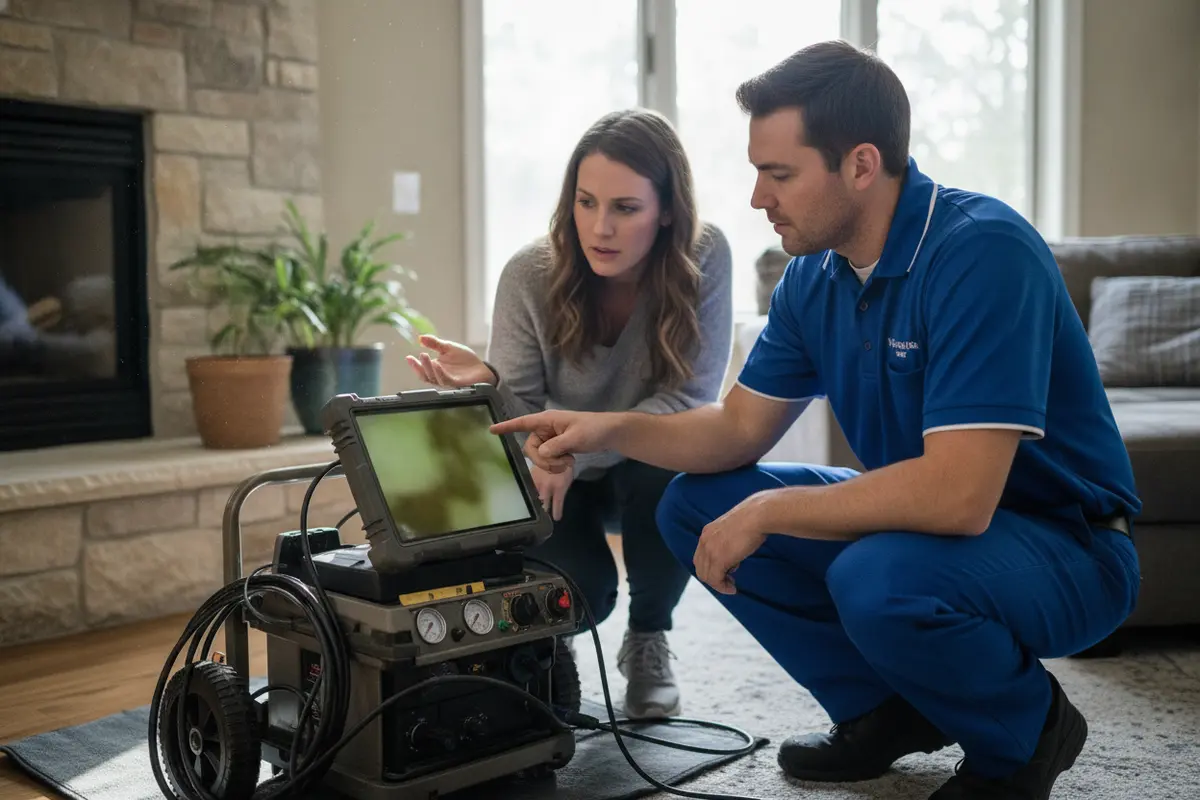
The plumber may review accessible plumbing and determine whether to examine a drain or the sewer line. A sewer camera inspection can show visible conditions inside the line and help locate an observed restriction or defect. The camera view is one part of the assessment: the plumber must interpret what is visible alongside the property layout and the limits of the view. Ask what was directly observed and what remains uncertain.
When discussing findings, it can help to separate three things: the symptom you reported, the inspection observation, and the recommended work. For example, a recurring backup is a symptom; an obstruction visible at a particular section is an observation; clearing or repair is a proposed response. Ask the plumber to explain how the proposed scope addresses the observed condition, and what additional information would change the recommendation.
Mr. Pipey offers sewer camera inspection as a diagnostic service. Depending on what an assessment shows, the next step could involve targeted drain service, a repair, or replacement. If a removable blockage is identified, professional HydroScrub drain jetting may be relevant. Clearing a restriction is not a substitute for diagnosing structural damage, and not every line or condition calls for the same service.
What should homeowners ask before approving sewer line work?
Before approving work, connect the proposed scope to what the assessment found. A clear discussion covers where the condition is, what work is recommended, what is included in the estimate, and how the result will be checked. If more than one approach is available, ask how each addresses the observed condition and what access or restoration may be involved.
- What did the inspection directly show, and where is the affected section?
- Is the confirmed issue a restriction, a damaged pipe, or another condition?
- What work do you recommend, and why does it fit these findings?
- What is included in the scope: locating, access, testing, cleanup, or restoration? What is excluded?
- Would a targeted repair or a larger replacement make sense, and what determines that choice?
- Will the work require excavation, or could a trenchless method suit this line?
- How will you verify the condition after the work is complete?
- What should I expect regarding access to the property and the areas affected by the work?
A useful estimate should let you understand the work being proposed without treating an unconfirmed symptom as a diagnosis. If you are comparing options, compare scope as well as method: what part of the line is addressed, how the crew will access it, what restoration is included, and how the result is checked. A different method is not automatically a better fit if it does not address the condition identified in the inspection.
Trenchless options depend on pipe condition, layout, access, and the type and extent of the issue. They are not suitable for every sewer line. A trenchless sewer repair assessment can help determine whether that approach is practical for a particular property. Ask the plumber to explain both suitability and limitations before choosing a method.
How do sewer line service options compare?
The appropriate service path follows the assessment findings. This comparison outlines broad categories of professional work; it does not assign a diagnosis, price, or guaranteed outcome to a home that has not been evaluated.
| Service path | When it may be considered | What to clarify |
|---|---|---|
| Drain evaluation and clearing | Findings point to a removable restriction without a confirmed structural repair need | What caused the restriction and how the result will be checked |
| Targeted sewer repair | A specific damaged section is identified and a localized repair is suitable | Exact location, access plan, work limits, and testing |
| Trenchless repair | Pipe condition and site requirements support a trenchless method | Eligibility, method, limitations, and verification |
| Sewer line replacement | Inspection findings indicate repair is not the appropriate scope | Replacement limits, access or excavation, restoration, and schedule |
These service paths are not interchangeable. For example, clearing may restore flow when a removable restriction is the issue, but it does not repair a structurally damaged pipe. A localized repair may address a specific section, while replacement may be considered when findings show that a broader scope is warranted. The plumber should explain the evidence behind the recommendation and discuss reasonable alternatives that fit the property.
When the next step is an assessment, keep the goal simple: understand what was observed, where it is, and what the proposed work is intended to resolve. If the line is not suitable for a trenchless approach, ask why and what other scope is recommended. If a repair is proposed, ask how its limits relate to the location and extent of the visible condition.
How can Ann Arbor homeowners prepare for a sewer assessment?
You do not need to diagnose the line before arranging service. A short, accurate record of events can help focus the visit. Note the fixtures involved, the date symptoms began, whether they happen together, whether an active backup is present, and whether the issue returned after earlier service. Mention any known sewer or drain repairs and relevant changes around the property.
Describe the sequence rather than guessing at a cause. For instance: “The basement floor drain backed up when the upstairs toilet was used, and two sinks have drained slowly since Tuesday.” That gives the plumber concrete observations to assess. “The sewer is broken” states a conclusion that may not yet be confirmed.
If a backup is active, say so when arranging service and follow the plumber’s instructions about using affected fixtures. Avoid sending more water into a fixture that is backing up. If symptoms are intermittent, note when they tend to occur and which fixtures were in use. A quick timeline can help distinguish a recurring pattern from an isolated event.
Homeowners with basement concerns may also want to describe the exact location of the symptom; a basement drain assessment can be relevant when a lower-level drain is affected. Share changes in yard conditions as observations, not as proof of a leak. The more precise the details, the easier it is to choose a focused assessment.
Request professional help with a sewer line concern
Frequently asked questions about sewer line problems in Ann Arbor
Does one slow drain mean the sewer line is damaged?
No. A single slow fixture may have a local cause. If multiple fixtures are affected or symptoms repeatedly return, share that pattern with a plumber so the relevant section can be assessed.
Are gurgling drains proof of a sewer line problem?
No. Gurgling can have more than one cause. It is useful to mention, especially when it occurs with several slow drains or recurring backups, but it does not confirm a sewer line defect.
Can a camera inspection show where a sewer problem is?
A sewer camera can help a plumber view the line and locate visible conditions. Ask what the inspection showed, where it appeared, and what limits affect the conclusion.
Is trenchless sewer repair right for every Ann Arbor home?
No. Suitability depends on the pipe, the location and extent of the issue, access, and site conditions. A professional assessment is needed before choosing a repair method.
What information should I provide when I call?
Describe the affected fixtures, timing and frequency, any active backup, and previous drain or sewer work you know about. Include relevant yard or property changes as observations.
A clear symptom history and a professional inspection help Ann Arbor homeowners understand whether a concern is local or involves the sewer line, and which next step fits the findings.